Monday, 17 March 2014

Malaysian MH370 – Too Many Cooks

On 8 March 2014, Malaysia Airlines’ Boeing 777-200ER disappeared into thin air. On board were 227 passengers and 12 crew members from 15 countries.

The following are the stories and wild speculations aimed at obfuscating the truth. The italicised text has been collected from various sources on the internet; the comments are my own.

Lost contact

The aircraft last made contact with air traffic control less than an hour after take-off. Its last known position at 1:30 a.m. was over the navigational waypoint IGARI (N6°55′15″ / E103°34′43″), heading eastward. Having passed into Vietnamese airspace just north of IGARI where contact was lost, it was expected to contact Ho Chi Minh City Air Traffic Control but failed to do so.

Commercial flights carry limited fuel which is enough to carry them to the destination, or to the alternate airfield in case of a diversion, in addition to 30 minutes of aerial holding over the alternate.  They cannot keep flying for hours without making contact with ground controllers.

Each operator is required to file an ATC flight plan that is followed meticulously by the pilots and monitored closely by the Air Traffic Controllers. If a pilot misses reporting a navigational position, the controller will call him several times. And if that effort fails, he will ask other aircrafts to establish contact. To overfly countries requires prior permission and one cannot keep flying over restricted or dangerous airspaces without serious repercussions such as being intercepted by fighter aircrafts or worse, being shot down.


Other aircraft’s call

The New Straits Times reported on 9 March that the captain of another aircraft had attempted to reach the pilots of MH370 "just after 1:30 a.m." to relay Vietnamese Air Traffic Control's request for MH370 to contact it. The captain said he was able to establish contact but just heard "mumbling" and static.

One will hear mumbling only if the microphone pushbutton is intentionally kept pressed, for example, in case of a hijack situation when the pilot would want other aircrafts to partially hear what is going on in the cockpit. In this scenario, other aircrafts will treat the frequency ‘jammed’ because they will be unable to transmit.

Static in communication may occur due to poorly maintained radio equipment, during thunderstorms, or when electronic interference is being experienced. Electromagnetic storms can also effect communications. An unlikely scenario is that the Malaysian crew used the noisy long-range High Frequency (HF) instead of the normally clean VHF radios to establish contact.


No distress signal

Malaysia Airlines issued a media statement at 07:24 confirming that contact had been lost at 02:40 and that search-and-rescue operations had begun. It later emerged that Subang Air Traffic Control had lost contact with the aircraft at 01:22 and notified Malaysia Airlines at 02:40. Neither the crew nor the aircraft's on-board communication systems relayed a distress signal, indications of bad weather, or technical problems before vanishing from radar screens.

This is most abnormal. During emergencies or during conditions of urgency and distress, the pilots will always alert the authorities through voice communication and by selecting special transponder codes—unless an aircraft is blown out of the sky in an instant.

Unauthorised persons cannot enter the flight deck because its steel-reinforced door is always kept locked by the crew from inside. Allowing someone access to the cockpit remains the captain’s privilege and responsibility who might verify the visitor’s identity through multiple video cameras, via the flight intercom or through a peephole.


ACARS

Malaysian Airlines reported in its eleventh press release that all of its aircraft are fitted with an Aircraft Communications Addressing and Reporting System (ACARS), a system that automatically transmits data about the status of the aircraft, and added "Nevertheless, there were no distress calls and no information was relayed." Malaysian officials declined to comment on whether they had any ACARS information.

Why would they not share this information? Relatives of the missing passengers have stood up to openly accuse Malaysian Airlines of “covering up details”.


Going westwards

On 11 March, it was reported that military radar indicated the aircraft had turned west and continued flying for 70 minutes before disappearing from Malaysian radar near Pulau Perak; and that it was tracked flying at a lower altitude across Malaysia to the Malacca Strait. Its location when disappearing from radar was approximately 500 km (311 nm) from its last position in contact with air traffic control. The next day they denied making the statements as reported in the media, requesting that the reporting be "amended and corrected to prevent further misinterpretations of what is clearly an inaccurate and incorrect report".

Who initially made the “inaccurate and incorrect report” and on whose orders?


Going down into Indian Ocean

A senior official at The Pentagon told ABC News: "We have an indication the plane went down in the Indian Ocean." On 13 March the White House Press Secretary said "an additional search area may be opened in the Indian Ocean" based on "some new information".

Surely the White House and the Pentagon know everything that happens in this world through their spy satellites. Can they show to the world images as proof of their “Indian Ocean” pudding?

Millions have already asked: “What were American agencies doing on the morning when 9/11 happened? How many officials were punished and how many agencies disbanded to atone for the sins committed on that fateful morning?” The American public claims it already knows the truth, is reluctant to surrender the guns to the government and is visibly upset about freedoms being taken away on various security-related pretexts.


Kazakhstan-Turkmenistan links

Malaysian Prime Minister said at 08:11 Malaysian time on 15 March that the signals might have originated from as far north as Kazakhstan. Razak said that the last signal was in fact in one of two possible corridors: a northern corridor stretching approximately from the border of Kazakhstan and Turkmenistan to southern Thailand, or a southern corridor stretching from Indonesia to the southern Indian Ocean.

Why did the Prime Minister point in Russia’s direction? What signals was he speaking of? VHF voice communications are typically line-of-sight and cover approximately a 200 nautical mile radius over flat terrain.


Oil slicks

The search efforts generated more false leads. An admiral of the Vietnamese Navy reported that radar contact with the aircraft was last made over the Gulf of Thailand. Oil slicks were located off the coast of Vietnam on 8 and 9 March and were thought to have possibly arisen from the aircraft. Test results reported on 10 March indicated that the oil slicks did not contain aviation fuel.


Aircraft door

There were reports that a door or other fragment of the aircraft was found about 80 km (50 miles) south of Thổ Chu Island on 9 March. The following day, the Department of Civil Aviation Malaysia reported these claims were untrue; the floating material was not from an aircraft.


Burning aircraft

The same day, a worker at the Songa Mercur oil drilling platform claimed he had seen an aircraft "burning at high altitude ... in one piece", about 50 to 70 kilometres (31 to 43 mi) away at around the time MH370 disappeared.

What happened to this man’s claim? Has he been whisked away by the authorities because he opened his mouth?

Satellite imagery

China released satellite images captured three days earlier that showed three floating objects measuring up to 24 by 22 metres (79’× 72’) at 6.7°N 105.63°E. However, no floating objects were found at the suspected crash area.

DigitalGlobe, a satellite imaging company, released all images of the search area over the flight path from its satellites and asked the public to look for and tag any images they believed might assist in the search.

Why do they what ordinary people to tag pictures unless they wished to find out how much the public really knows? Indeed, the public has a collective brain that is far better than any government’s dizzy head. Spy satellites reading automobile number plates and collecting personal data of ordinary citizens have become realities but what good have the expensive ‘eyes in the sky’ ever done in cases as tragic as the Malaysian Airlines flight MH-370? With the spy satellites capable of yielding images with greater than 1-metre resolution, anything can be now clearly seen from space. Is the evidence of wrong-doing being removed from the crime scene by some agency? Was the airplane carrying dangerous cargo that was prevented from ending up in Chinese hands?


Military radars

Malaysia initially declined to release raw data from their military radar as it considered them too sensitive, but later acceded. Defence experts say that giving others access to radar information may be sensitive on a military level. As an example: "The rate at which they can take the picture can also reveal how good the radar system is". Someone suggested that “some countries may already have the radar data of the plane but are reluctant to share any information that could potentially reveal their defence capabilities and compromise their own security.”

The military operates primary radars while the civil aviation authorities use secondary radars. Only they can tell us what levels of data they preserve and for how long. If all the cooperating governments wanted a truthful solution they would share information amongst themselves instead of peddling half-baked theories and changing statements to confuse the public.


Submarines in the area

Submarines patrolling the South China Sea will surely have information if the airplane crashed into the sea but then sharing such information could reveal the submarines' locations and electronic listening capabilities. The Vietnamese, as a gesture of goodwill and cooperation, did allow Chinese aircrafts to overfly its airspace.

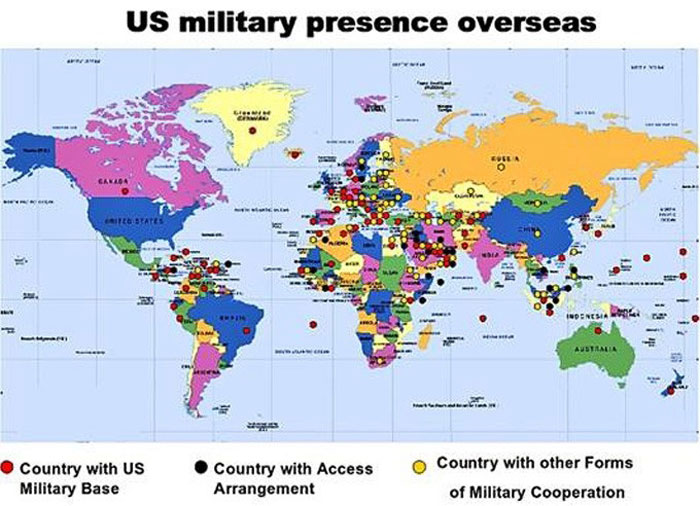
The public needs to ask: of what use are the trillions of Dollars’ worth of military high-tech toys spread all over the world? Why do submarines, fighter aircrafts and tanks always appear extremely busy with ‘war exercises’ but achieve very little in peaceful directions?

The 'American boys' are everywhere except in their own country

Hijacked: to where, by whom, for what?

On March 8, Prime Minister Najib Razak told a nationally televised press conference that “communications aboard a missing jet were switched off and its course deliberately c
hanged by someone on board before the aircraft disappeared a week ago.”

He stopped short of saying it had been hijacked. Final satellite communication with the Boeing 777 flying from Kuala Lumpur to Beijing came more than six-and-a-half hours after it vanished from civilian radar at 1:30 am.

The movement of the plane in the interim period, during which it changed direction and passed back over the Malaysian peninsula towards the Indian Ocean, was consistent with deliberate action by someone on the plane. The combined data suggested with a high degree of certainty that the plane's two automated communications systems — Aircraft Communications Addressing and Reporting System (ACARS) and its transponder — were switched off one after the other before it reached the point over the South China Sea where it dropped out of civilian radar contact.”

The Malaysian authorities also first admitted that disconnecting the ACARS required “a great deal of expertise”.

Perhaps they would like to shed some light on the level of such expertise. Does it mean disabling something in the cockpit or descending into the electronics bay of the aircraft? Nobody can just get up to interfere with sensitive equipment unless it is a specially trained saboteur on a suicide mission.


Psychological problems

Malaysia’s inspector general of police said they were investigating a range of theories including hijacking and sabotage, but also any possible psychological problems of those on board.

There is no human being on Earth who has no emotional or ‘psychological’ problem; tragedies can visibly upset human beings. Do the authorities have the right to deny you air travel because you are not dressed right or the facial recognition software does not like your physical features? Do they all want us to become unfeeling expressionless robots while moving about in society? Will men in white coats soon be conducting last-minute medical tests on passengers or have psychologists looking inside suspected heads?


International Police

Interpol Secretary General Ronald K. Noble was quoted as saying at a press conference: “I have announced that Qatar Airways and Air Arabia are two airlines that have committed themselves to making sure that all passengers boarding their planes will have their passport data screened against Interpol's database.”


Air Arabia and Qatar Airways will be using a specially designed programme called I-Checkit, to query the database, but not access it fully. The airlines were chosen was because they had approached Interpol and expressed an interest. Interpol plans to expand the programme to other airlines and private sector companies after the test phase.

Interpol revealed that more than one billion travellers boarded planes last year without their passports being checked against the database, as only a few countries, such as the United States, Britain and the UAE, actually used it.

Read my lips: the French want your money too. They intend to make the skies ‘safer’ by charging the airlines money for background checks of passengers’ passports; the airlines will in turn charge their customers. Selling information is big business now.


Communications disabled
It is very likely flight MH370 had its communications “deliberately disabled” before it went missing, but there has been no confirmation the plane was hijacked, Malaysian PM Najib Razak said at a press conference. “There is a high degree of certainty” that the communications systems of flight MH370 were disabled by someone on board the plane, Razak said. Citing evidence from satellite images and radar tracking, Razak said the actions taken before the plane’s disappearance were "consistent with the deliberate action of someone on the plane."

The aircraft’s communications system is not a television that can be turned off by a civilian using a remote control; it can however be jammed by the military.


Biased western media’s attack on Pakistan

With nothing else left in their arsenal except accusations, reports came in that claimed that the missing Malaysian flight MH370 might be “hidden somewhere in the country [Pakistani]."

Malaysia is reportedly investigating a theory that flight MH370 could have slipped under Pakistani radars and landed a Taliban base close to the Afghan border. The pilots’ possible role in the plane’s disappearance is also being examined.

A Boeing 777 is a huge airplane. Be afraid because Obama could send his Seals to look for the missing plane at Abbotabad, for that is where they ‘found’ their asset Osama bin Laden, courtesy of another asset who pretended to vaccinate children against polio.

Thus far, 6 Navies, the combined technological expertise of 26 countries and 95 sea vessels in the Indian Ocean have not been able to recover the lost airplane. Blaming the Taliban or the al-CIAda for all of their security-related woes is truly amazing?

Hijacking by Iranians

There were two Iranians aboard the MH370 who ‘hijacked’ it using ‘stolen passports’.

Just ask yourself: who benefits from this insinuation? Why, John Kerry, Barrack ‘drone’ Obama and Israel; they all want Iran turned into another Iraq or Libya! The Iranians will never stop chanting “death to America, death to Israel” because they firmly believe Allah will scatter their enemies like dust.


Malaysia and Muslim crew made to look suicidal

An Australian television station broadcasted an interview with “a South African woman who alleged she and a friend were invited into the cockpit of a flight that Fariq co-piloted in 2011 – a breach of post-9/11 security rules.”


The military investigators stressed upon how the airplane was “commandeered by a skilled, competent, and current pilot who knew how to avoid radar”.

First of all, aircraft engineers (maintenance staff) are taught things that commercial pilots are neither taught nor required to do while flying. Pilots, unless they are military pilots, are neither taught radar evasion manoeuvres nor allowed to switch off key navigation or communications components of commercial airliners.

The Malaysian Prime Minister casting doubts on the captain of the airplane is truly phenomenal. What are the Malaysian authorities implying? Why would they hurl such accusations without first listening to the cockpit voice recordings or without having the investigation results placed before them?

The police also looked at the family life and psychological state of the plane's pilot, Zaharie Shah, and co-pilot. They searched their homes, spoke to relatives of the pilots and examined the pilot's flight simulator at home. Those who knew Capt. Zaharie claim he is a “normal family man” of fifty-three, and with 18,000 hours of flying experience, he is a self-confessed "aviation geek" who posted pictures online of the flight simulator he built at home.

Why are the grieving families of the crew members made to feel guilty at this point in time? The mass media which is controlled by a handful of corporations is again diverting the public’s attention by focussing on Muslim pilots from a country with a predominantly Muslim population. By planting false stories, they are harassing the families of the crew members through invasion of privacy. Any shred of ‘evidence’ that the police might pick from the homes of crew members can and will be used to support official findings—if at all they ever come.

For a pilot to build model airplanes or use flight simulation software at home is not abnormal; even non-pilots have such hobbies. Do the police ever visit the homes of political or military leaders after they have caused the deaths and destruction of their own or others’ countries? I think they ought to in the future.


Everyone's a potential criminal

Malaysian investigators are probing the background of Mohd Khairul Amri Selamat, an aviation engineer who was among the passengers on board the passenger jet that went missing more than a week ago. “We are looking into Mohd Khairul as well as the other passengers and crew. The focus is on anyone else who might have had aviation skills on that plane,” a senior police official said Monday on the condition of anonymity.

So now, anybody, even aircraft engineers who sometimes aboard to provide technical coverage, are suspects; so are aviation buffs whether adults or children found playing with toy airplanes. The aviation industry and the travelling public are the targets now.  

So, what is coming?

In the meanwhile, India has temporarily suspended the search for the missing Malaysian airplane.


Important data and evidence are being ‘recovered’, history is being manufactured and perhaps one more draconian law is being drafted to end one more liberty cherished by mankind.

In the part two of this article, we will look at historical records of a few crashes. Prepare yourself to be truly amazed by what goes on behind the scenes, how lies are spun for public consumption, and how the mass media ‘cooperates’ with the vested interests.


©Tahir Gul Hasan 2014

Related stories:
Part-2 Malaysian MH370 - New Tricks, Old Game
Part-3 Dead Men Fly No Planes

Acknowledgment
Malaysian Airlines aircraft http://malaysiaairlines.com/hq/en/book-and-plan/flight-status.html
US military presence overseas http://www.bibliotecapleyades.net/imagenes_sociopol/globalmilitarism172_01.jpg

Sunday, 26 January 2014

The Things I Did For Mrs. Davey

Mrs. Davey's double
Totally Anglo and quite non-Indian by the looks, Mrs. Mary Davey was my Anglo-Indian class-teacher in section-B of class four at school. As of this writing, only two out of seven members of her family are alive. Luckily I was able to obtain important details about Mrs. Davey’s family from her eldest daughter, Noreen, popularly known as Papu.

Mrs. Davey’s parents belonged to an affluent Armenian Jewish family of Rangoon, Burma (currently Yangon, Myanmar). On the ground floor of the third block on Lahore’s famous lane 3 of Temple Road, my teacher lived as our next doors neighbour with her husband, two daughters (Noreen and Daphne) and three sons (Clayton, Adrian and Llewellyn). The inhabitants of Temple Road were jokingly called Roads Scholars.

Mrs. Davey’s sons and most boys within the radius of many miles—including yours truly—studied at the English-medium all-boys St. Anthony’s High School. Other noteworthy schools in Lahore were Cathedral and the Aitchison College. The former was nicknamed ‘kaddu’ or pumpkin school for reasons beyond comprehension while the latter attempted to educate the sons of horse-trading tent-pegging elites. The rest of the lads fell into the cracks of Centre Model or Don Bosco schools. Although the first choice for the fair sex was the Convent of Jesus and Mary, other likeable institutions were Queen Mary’s, Cathedral, Sacred Heart and Esena Foundation.

The stocky Mrs. Davey of St. Anthony’s walked with considerable effort and was thus instantly identifiable even from great distances. Fair-skinned, sporting short hair, with a front tooth or two missing; these were the physical attributes that made Mrs. Davey appear jovial even when she angrily foamed at the mouth. She always wore sleeveless dresses which exposed her fleshy arms to us skinny brown children w-ho felt intimidated by the superiority associated with white power.

My mother, herself tall and fair, made the Daveys feel so right at home that when the couple indulged in shouting matching, the poor husband dressed in cotton trousers and singlet (spaghetti straps), headed straight to my father’s home-office to mumble, “Woh pagal aurat phir hum say jhajra karta (that mad woman is again fighting with me)”. The husband was never taken seriously because he would not give up the bottle, and Mrs. Davey could not keep her sentiments bottled up. And my father, being an advocate at both the High and the Supreme courts, thought their entire case was like a message in a bottle worth tossing back into the sea.
Direct from the Shimla Pahari

Up In Smoke

Mrs. Davey’s husband, Clarence, was a lean bald man who worked at the USIS (United States Information Service or the ‘Umrikan Santer’) located inside the Bank Square on the Mall Road of Lahore. His father, a Catholic Welshman, worked for the telegraph office in India. In 1944, somewhere in that incredible country, Clarence met Mary and the new family decided to move to the Land of the Five Rivers: Punjab.

To us children Clarence Davey always appeared to be loosely hanging about the house reading voraciously and smoking ceaselessly. As fate would have it, while simultaneously smoking and reading Ernest Hemingway’s classic For Whom the Bell Tolls, he tucked himself snugly in bed and fell asleep mumbling, “And therefore never send to know for whom the bell tolls; it tolls for thee”.

Fire, being nobody’s friend, soon filled the Daveys’ house with thick smoke that lazy winter afternoon. And quickly the fire engines of Shimla Pahari, their tolling bells not half as musical as those of St. Anthony’s church, appeared at the burning Davey doorstep. Someone promptly alerted Mrs. Davey at the school. By the time she arrived at the scene, the fire engines had already given the house the wash it richly deserved. The old furniture, the dusty carpet, a coughing Clarence Davey and his panting dog, all got a free bath. Television had yet to make its appearance in Pakistan but Clsdarence Davey’s negligence produced the greatest live show the neighbourhood had ever seen up to that point.

In his private moments, Clarence Davey always spoke about ‘going back home’ which, without any doubt, referred to setting sail for ole’ England. But in 1966, at age fifty-two and before being able to transport the entire family back, he sailed for his final abode.

What’s Cooking?

The first thing I experienced upon becoming Mrs. Davey’s pupil was her showering generous amounts of affection by assigning me a location in the classroom that enabled her to keep a special eye on this boy who lived next doors. I do not recall her ever hitting the pupils—corporeal punishment had not yet descended upon us—but she loved labelling every careless student ‘blooming good-for-nothing fella’. In those days we knew absolutely nothing about expensive branded apparel, hence, hearing a class-fellow being branded ‘blooming’ always produced smiles that were impossible to hide behind our little palms. I generally steered clear of trouble by doing pretty much what was required at school but the less fortunate who approached Mrs. Davey’s desk with incomplete assignments had their copybooks flung on the floor and from where they slid magically into the wide corridor as if carried upon invisible wheels. One morning when half the class was resting heads down, I was summoned by a smiling Mrs. Davey.

“Haaa—haaa— ”, she exhaled over her prescription glasses, wiped them clean with a handkerchief and snapped, “Come closer, will you? I won’t bite you!”

I moved forward until I could smell her Indian Englishness.

Knowledge with Virtue
“Aaj mummy nay kya paka (what has mummy cooked today)?” she questioned.

I held on to my shorts—knickers, as they were called—as I imagined they were suddenly being pulled down by an invisible Jinn. Utterly ill-prepared was I to instantly and correctly answer her question because it involved knowing our kitchen’s geography and mother’s cooking history. But recalling what mother cooked most often, I replied shyly, “Aalu-gosht!”

I must confess that as a young boy I barely showed any appreciation for the subtle variations of aalu (potato) and gosht (mutton) which mother frequently cooked in a humble smoke-filled kitchen. If I felt disinterested in the menu—a frequent occurrence—I simply walked up to Regal chowk to feast on eatables that the street offered and which mother expressly forbade me from eating, namely: spicy dahi bara, hot samosas, or sizzling aalu ki tikia (potato cutlets). Since McDonalds—worthless plastic food—had not yet appeared on the scene to destroy youthful innards, I had blind faith in the nutritional value of my rebel’s menu whereas mother believed it had great nuisance value.

Mrs. Davey did not look particularly happy with my aalu-gosht revelation. For her Jewish- Armenian-Burmese palate some ‘blooming’ potatoes and chunks of mutton floating about in a broth probably did not produce the same mouth-watering effect as say chicken biryani or a roasted leg of lamb. But then pretending to love aalu-gosht she whispered in my ear, “Mummy ko bolo, thora sa hum ko bhejna (ask your mother to send me some)”.

The classmates seated nearby only heard a garbled version of her aalu-gosht request and later asked me during recess what Mrs. Davey meant by hollow ghost.

I was to discover very early in life that I was blessed with aalupathic abilities if not telepathic ones. Upon reaching home, I whispered Mrs. Davey’s secret demand into mother’s ear and found that that was precisely what she had cooked. With plenty of aalu-gosht about the house, mother dished out a generous portion for me to deliver with full protocol at my teacher’s doorstep.

Mrs. Davey was thrilled to be on the receiving end, smelled the dish deeply and said, “Mummy ko thank you bolna (convey my thanks to your mother)”.

The next morning at school, thanks to mother’s cookery and generosity, I became the apple—or perhaps an aalu—of Mrs. Davey’s eyes. Some times in the middle of teaching at the blackboard, she would turn to look at me and smile. I quickly learned to smile back. At least once a week, she would ask, “What’s cooking?”, and upon hearing an appetizing reply, utter with a twinkle in her eyes, “Lovely!”

This short dialogue dramatically improved my spoken English, and since I imagined that my scholastic future in class four depended on what I was able to deliver at Mrs. Davey’s doorstep, I made it my business to know each morning what mother planned to cook. Mother might have been secretly thankful to Mrs. Davey for it was because of her that a son had begun to enquire about home-cooked food, and that perhaps one day he would eat at home instead of lick his fingers in public at the food stalls of Regal chowk.

One afternoon, when I home-delivered aromatic mutton stew at Mrs. Davey’s she became as ecstatic as a whirling dervish and requested, “Mummy say bolo, thora aur bhej do. Sath mein chaar tandoor bhi lana (Ask your mother to send some more. And bring along four rotis as well)”.

On the double, I relayed the message back to mother’s headquarters—the kitchen—where I found her facing the stove slapping away rotis in the oppressive heat. Unpleased to the core she retorted, “Cook ME and then dish ME out to that moti mame!”

The Urdu word mame, since British colonial times, has been used exclusively to refer to fair English ladies; from this emerged the honorific title mame sahib. But the pet-name, moti mame, meant fat lady. It was not my mother who bestowed the title upon Mrs. Davey but rather her eldest son, Clayton. He was a skinny sharp-featured rebellious young man who refused to walk with his mother on the same side of the road as he felt his skeleton contrasted sharply with a huge motherly frame. He teased his mother by calling her names, and moti mame was a nickname that became more known than Mrs. Davey own name.

You are my candy girl...
Sugar, Sugar (as performed by the Archies)

Mrs. Davey was in the habit of having Pakistani tea in English style. Before noon each day she would command her favourite errand-boy, “Naseemullah, my boy, run to the tuck-shop and tell that Mushtaq fella to bring for me half a set of tea”.

When I heard the term ‘half a set’ for the first time I thought she ordered tea for the well-behaved half of the class but when Gul Khan, the tea-bearing Jinn, appeared with a small tin tray I knew she meant tea just for one. None thought it odd that our teacher consumed tea in class. But what I found strange was this: at the end of her lonely tea party, Mrs. Davey opened her cupboard, unscrewed a small glass jar and emptied the sugar-pot into it. I was able to see a pattern: on Monday the jar would be empty, by Saturday quite full, and then empty again on Monday. All that sugar was certainly going somewhere and Mushtaq, the tuck-shop owner, appeared to be the sweet loser in the battle.

Sugar was a hard commodity to find in those days hence, Mrs. Davey did not steal sugar but rather practised the same ‘doctrine of necessity’ that every military dictator (Mil-Dic) from our history has practised. For this story we need only look at General Ayub Khan, Pakistan’s first Mil-Dic and martial law administrator (Mal-Admi). Having grown up in the ancestral fields of Rehana, he conferred upon his self the medieval grand title of Field Marshall, meaning, keeper of the king’s horses. But the public, always quick to respond, nicknamed him cheeni-chor (sugar thief) because his unelected government issued ration cards to the populace and increased the price of sugar from eight Annas (half a Rupee) to ten Annas per seer (approximately a kilogram).

Ayub, who considered himself and his colleagues superior to ‘corrupt politicians’, went on to debase democracy to the most ‘basic’ level, held a dubious national referendum, and boasted such enviable connections with Uncle SCAM Mohtarma Fatima Jinnah, the sister of Muhammad Ali Jinnah (founding father of Pakistan). State propaganda was able to convince the voters that Ayub’s election symbol (rose) had the ability to grow if it rained but that of the Mohtarma (lantern) was doomed to be snuffed out.

Suffice to say, the long and painful history of foreign invasions and martial usurpations of ‘bloody’ civilian’ rules in this entire region makes Mrs. Davey’s sugary naughtiness pale into such insignificance that it must be posthumously hailed as a brave attempt to conserve a scarce national resource: sugar.

Going Cuckoo
One flew over the cuckoo's nest

Returning to the story, all the three-storeyed flats in lane 3 on Temple Road had similar facades; they were built by a rich Hindu landlord prior to the genocidal Made-in-England partition of India in 1947. Right after entering into any of these flats, one landed in a living room with a 16-foot high ceiling, complete with two roshan-daans (ventilators). And it was always in the living room where Mrs. Davey gave me private tuition of a quality so fine it convinced my well-read father I could spank the British in English language.

My huge female Buddha-like teacher always sat on an upholstered sofa, and behind her on the wall hung something that truly fascinated me: a German cuckoo clock complete with sadomasochistic chains and levers. The marginally accurate contraption sometimes upset Mrs. Davey by cuckooing at the wrong moments—chiefly those during which she snoozed. Because it was the only time-keeper around, she never was able to smash it despite frequently swearing that she would. Instead, she would have me pull various levers that dangled below the ‘blooming thing’ and which achieved three miracles: the tic-toking restarted, the dead cuckoo arose from the grave, and the Earth resumed spinning on its tilted axis. The resurrected cuckoo’s soft cuckooing never failed to make my teacher happily sink back into the sofa for one more quick nap, and to deliver most of those English lectures while snoring sonorously. And while the fat cat slept, I sat quiet as a mouse, wondering how the cuckoo was able to live in a tiny wooden flat that was housed inside yet another flat on the greatest road of them all: Temple Road.

Snow White and the Dwarf

What deeply worried my school teacher was this: she was beginning to get old while I grew younger by the day. Since I had become proficient at raising dead clocks, Mrs. Davey cultivated one more hair-raising talent in me in order to reverse her aging process. Before imparting linguistic secrets in English, she would first have me take care of the cuckoo-clock and then stand me in the rear to hunt down all the white hairs I could find in her Armenian-Burmese-Jewish scalp. I turned white with fear doing that for the first time as I thought it might make her bleed to death right there on the sofa, and that a policeman from Mozang thana might handcuff me for stealing her precious silver hairs. But no such tragedy befell when I gave a long white hair my first vicious pull.

“Come on man, show that blooming thing to me!” she thundered for the evidence.
She loved using the word blooming. I produced the white proof and she threw the blooming thing on the carpet where her sleepy dog too saw it fall. And so, like many other things in life, I soon became adept at sustaining a younger look for my aging class-teacher. I might have been her best kept secret because had she mentioned me to other aging ladies of the locality, they might have whisked me away to do the same chore for them for free. And so the home-deliveries, the private tuition, the clock winding, and the pulling of white hairs continued as if I were marked to become the sugar-lady’s man-servant. Of course, my parents never discovered all the chores I performed for Mrs. Davey.
McPig (with French flies) anyone?

Forbidden Food

Then one day Mrs. Davey asked me to eat a little something at her house—very unusual considering it was mostly our food that frequently graced her dining table. What I got was a portion of a thin slice, pink in colour, and meaty in taste. When I swallowed it, my teacher smiled with an approving nod and sent me home early. And when I described for my mother what I was given to eat she shouted aloud, “Oh Allah, moti mame nay tumhein soowar ka gosht khila dia (Oh God, the fat lady fed you with swine flesh)!”

I suddenly felt Christian, then Jewish, and finally Armenian. Mother’s good neighbourliness and patience suddenly vaporized and she tried to re-convert me to being Muslim by inserting her fore-finger deep into my throat. The trick failed; I was unable to vomit the forbidden meat. It took until the next morning to flush out from my system the animal declared by the Lord as ‘unclean’.

Had this incident taken place in today’s utterly intolerant climate, the entire household of Mrs. Davey might not have survived the blitzkrieg of the Bearded Brigade. I do not recall seeing mother confront Mrs. Davey with rolled up sleeves but soon afterwards my visits to her house were put to an abrupt end. We never found out how pork, which was not sold in Pakistan, ended up in my teacher’s possession. All I was told was that Muslims, Christians and Jews were all strictly forbidden to consume it, and that Mrs. Davey had done to her student something totally uncalled for. Suddenly, I was back to being just another boy in her class who stayed away from her house, her clock and her silvery hairs.

Prime Sinisters
You too, Nehru?

During the Indo-Pak war of 1965, Mrs. Davey’s sons picked up a stray dog for a pet. Considering the officially-induced hatred Pakistanis displayed for Indians during that tense period and the Indian origins of the Davey family, the animal was named Nehru after India’s first Prime Minister. Then another son of the Temple Road soil, Ajji, picked up yet another dog and promptly named him after India’s second Prime Minister, Shastri.

While the ‘spiritless’ Indian army knocked at the gates of Lahore and risked being converted en-masse to Islam, and as our high-spirited soldiers dreamed of hoisting the star-and-crescent flag atop Delhi’s Red Fort, the boys at 3 Temple Road vented out their emotions on the poor dogs by garlanding them with old shoes and chanting, “Nehru kutta hai, hai. Shastri kutta hai, hai (down with Nehru the dog. Down with Shastri the dog)”.

Nehru was deeply touched by all those leathery medals and being smarter than Shastri, soon befriended a bitch-at-large befittingly named Edwina; the pack of ogling dogs were happily named Mountbatten 1, 2, 3 etcetera. Much later into adulthood I read about the alleged love-triangle of Indian history in which Lord Mountbatten did not mind very much if Jawaharlal Nehru addressed  Edwina as jaan (life) instead of the more appropriate bhabi jaan (dearest sister-in-law).

With or without Edwina jaan by his side, our own prime sinister Nehru roamed wherever he liked, ate whatever one fed him and slept like a log at the oddest spots. The Daveys owned him but he was the dog next doors, the dog that fully had his day, and everybody’s dog without a worthy pedigree. Although a depressing atmosphere of suspicion hung in the air during the 1965 war days, the intelligence agencies were able to clearly tell that Nehru and Shastri were not Indian agents. And we all saw Nehru bare the teeth and viciously scratch the ground when someone asked, “Nehru, do you wish to die fighting for your country?”

Nehru virtually dying for Edwina 'bhabi jaan'
An old gent who stood watching remarked, “Since Nehru has displayed anger over being asked this question; he is a foreign agent in dog’s clothing.”

A naked faqir laughingly remarked, "He is indeed on your side, and he will die fighting long and hard if you promise him a bit of coloured ribbon".

Later in life I found out that the naked faqir, wiser than many fully clothed onlookers, had actually quoted Emperor Napoleon Bonaparte on the subject.

Now that my hairs are greying I am inclined to agree with the naked faqir. Today one can see loan-defaulting politicians working hand-in-glove with conniving bureaucrats, businessmen with armed guards, trained at our expense ‘security personnel’ taking over businesses, and small bands of ‘al-CIAda’ extremists spreading themselves thin over this Land of the Pure.

Thinking about our own canine Nehru I wonder what the deceased could have achieved by merely barking in defence of Pakistan at the Canine United Nations. He was a creature of habit that always bravely barked up the right trees under which no other dog even dared to relieve himself. True, Nehru loved chasing after Chevrolet Impalas yet never bit any living thing half Edwina’s size. I do not know where they buried brave Nehru who warded off strangers and stray dogs that ventured into our neighbourhood. I would like to imagine he is licking his paws in dog-heaven.

In 1978, another Mil-Dic named CIA-ul-Haq descended upon the nation to teach her democracy and to stamp on human faces a boot for almost forever. Ever since his mango-flavoured departure on an American-built intergalactic spaceship that boldly went to a place where many Mil-Dics had gone before, luck has favoured militants who would rather blow themselves up wearing suicide dinner jackets than enter barbershops in Pakistan for very close shaves.

And so in 1977, unable to stand one more Mil-Dic, Mrs. Davey, age fifty-nine, passed away and joined Clarence Davey to become a teacher in God’s divine no-medium school. I imagine the heavenly tea-bearers are busy fetching her half-sets of tea, that there are mountains of white sugar at her disposal, all kinds of curries and permitted roasted meats present themselves the moment she thinks of them, her cuckoo clock tolls louder than the Big Ben of London, and that all of Mrs. Davey’s silver hairs are now transformed into tresses of 24-Karat gold.

Dedication
I dedicate this real-life story to the memory of my 'class one' class-fellow, Akhlaq Ahmed, who passed away after protracted illness on 18 November 2013. I lowered his body with my own hands into the grave but he can still be seen in that class one' group photo I have. Of course, he will live in my memory as long as I live.

©Tahir Gul Hasan, 2014

References and grateful acknowledgements:
  1. The first in the 'nostalgia series' of articles dealing with my childhood is The Amazing T-Pad
  2. Unless you can genuinely proove otherwise, I coined the terms aalupathic, Uncle SCAM, al-CIAda, Mil-Dic and Mal-Admi, CIA-ul-Haq, and dog-heaven. Please give me credit when you use them.
  3. Twenty-five killed in plane crash (making Ayub Khan the winner in the C-in-C lucky draw of the Pakistan Army) 
  4. The Field Marshall From Beyond The Grave
  5.  America welcomes President Ayub, 1961
  6. Medieval jurist Henry de Bracton’s Doctrine of necessity: That which is otherwise not lawful is made lawful by necessity”. And Roman law maxim urged by Ivor Jennings: “The well-being of the people is the supreme law.”
  7. I have no idea where the images of Mrs. Davey's look-alike, the fire-engine and the St. Anthony's logo came from. But thanks anyway.
  8. Sugar-pot photo
  9. German cuckoo clock photo
  10. Pig photo
  11. Angry dog photo
  12. Henri Cartier-Bresson: photo of Lord Mountbatten, Edwina and Jawaharlal Nehru

Thursday, 12 September 2013

The Amazing T-Pad

High literacy under a tree
Then, the whining schoolboy with his satchel
And shining morning face, creeping like snail
Unwillingly to school.
—William Shakespeare, describing the second stage of Man in ‘As You Like It’

The one who introduced me to the amazing t-Pad was my mother’s only brother, a bespectacled man over six feet tall and a lawyer by profession. The exact year of this story is unimportant; suffice to say that Steve Jobs was still learning how to spell the word apple and humans had not yet learnt to camp outside shops to buy phoney temptations.

In those days, schools genuinely taught a thing or two, education had not become money-minting ‘information technology’, school-teachers never ran private tuition-centres, and the students lived happily ever after even if they secured less than straight A’s in examinations. 

This was when people received landline calls with great courtesy and noted down messages for those away from home, children played with each other for real, and street-smartness had not been assigned the rearmost seat in the theatre of life. In an era when industrialized nations had attained scientific prowess through education in their national languages, an elitist minority in the ‘land of the pure’ (Pakistan) ensured that Urdu emerged as the national language at the expense of richer regional languages. And George Orwell, having told revolutionary truths in his masterpiece novel ‘Nineteen Eighty-Four’, had already passed away and left us at the mercy of watchful Big Brothers obsessed with transforming the entire world into a Dystopia.

Strange ink-fellows

There were, in the ‘land of the pure’ two kinds of schools: Urdu-medium and English-medium. The Urdu ones meant for the masses used less glamorous teaching aids and sometimes taught in regional languages which, to the chattering elites, were ‘what domestic servants conversed in’. And the English ones produced future rulers who normally spoke English only within the school’s perimeter. The Irish Catholic missionaries who ran our school introduced paper and pencil to the students from the very beginning. A few years later when we bade farewell to innocent pencils, rubbers (erasers) and sharpeners to welcome the mighty fountain pen, some of us had still not seen what was designed to become less mighty than a sword: a ball-point pen.
Improving one's hand

Too young to know how the French writer, Marquis de Sade, derived pleasure by way of pain, we nevertheless turned our fountain pens—a modern pleasure—into menacing instruments to settle scores by staining our victims’ light blue shirts with dark blue jets of ink. No instruction manuals came with our writing implements; boys just knew how to unscrew the pen’s cap, hold the pen like a charging sword, and then rapidly jerk the nib in the direction of the intended target. Once the scapegoat reached home he received a severe reprimand from the laundrywoman: usually his mother.

Education was a serious matter. Because teachers loved copybooks filled with correctness, scribbling meant survival and failure led to instant corporeal punishment which was as readily available as oxygen to the lungs. To end up being inkless in class was the modern equivalent of having one’s mobile phone run out of credit or battery power. Those who habitually forgot their inkpots at home unashamedly begged for drops of ink in the middle of diligent pen-pushing periods. Instead of relying on audio-visual cues, every boy used extra-sensory PENception to tell when a brother was in need of ink. The donor, after mentally calculating how much one’s own ink chamber would last during the period, usually obliged by transferring an amount of ink that was directly proportional to the strength of friendship with the recipient.

Since all of God’s creatures knew how to go forth and multiply, our ink-chambers too competed wholeheartedly in the race for survival of the fullest. We were like air force pilots who performed air-to-air refuelling, we were ink-transfer artists who prided in returning home without soiling our uniforms or limbs with tell-tale ink marks. Later in life, only the bad artists amongst us faced domestic violence when they reached their homes with lipstick-stained shirt collars. The following episode will demonstrate how laughable our theoretical knowledge about the reproductive nature of life was at that tender age.

One morning, a teacher noticed two back-benchers ‘fidgeting about’ in the classroom. Angrily he waved his thin cane at them, “YOU two! Stand up!”

The aggrieved party stood up to protest, “Sir, he said that I was born when my father injected his ink into my mother.”

The whole class and the teacher produced roaring laughter because the teary-eyed complainant’s father actually owned a stationery shop.
Simca for the loveless

Such and other unmentionable anecdotes taught us one thing: throughout history the value of manly activity-based camaraderie ranked higher than womanly emotional sharing. How could we have possibly toned down our male attitudes when no crystal ball had shown us our future wives detest us for unwrapping ourselves from around their fingers to sit with old school friends?

Moths around a candle

All young male teachers and the entire students’ fraternity blew their dickies and bonnets on the day the principal installed young Madame Shama Utarid as class-teacher of our naughty all-boys grade five. Always driven by her mother, our teacher’s means of transportation was an early 1960’s camel-brown Simca 1000 of French origin. There was no other Simca on the city roads and there certainly was no other quite like Madame Shama in the entire world.

She ended up living up to her first name which meant candle in Urdu language. Daily she fended off fifty moths that pretended to be good students but in reality only craved for her fragrant proximity. The naughtier ones regularly used the Ma’am-I-do-not-understand-this trick, which required Ma’am to alight from her high desk, walk right up, bend over dangerously and attempt to explain innocently what we already knew. The principal stayed unaware of the fact that our beloved teacher had unintentionally turned a regular class into an imaginative crush factory.
Knowledge with Virtue

The boys used Royal Blue ink while all the teachers used red; I switched to green. From behind the stack of copybooks placed on Madame Shama’s desk, when she smiled I knew my handiwork had unveiled itself before her all-knowing eyes. Her frequent ten-out-of-ten tokens of admiration always arrived with golden stars of encouragement affixed to my copybooks, while her red artistic signature beautifully complimented my green efforts. And thus, through the miracle of my green ink I became her favourite student within a remarkably short span of time, and which turned my envious class-fellows into little green Martians.

During summer morning classes some of our less loved teachers resembled dreamy-eyed Buddhas—courtesy the sleep-inducing lassi (milk and yogurt cold drink) they gulped at breakfast. While pretending to be alert to our mischief, the illumined ones kindly permitted some to absent themselves from the class under the umbrella of the pen-wash excuse. The sages amongst us had already concluded without sitting under Banyan trees that like all human beings, pens needed washing too. The water-coolers, located at a central location in the school’s vast compound, facilitated staying away from tedious learning for almost ten full minutes—a great luxury considering that the single authorized half-break lasted a miserly fifteen minutes during which we chatted while playing, and visited Mushtaq’s tuck-shop for samosas (fried local patty with potato filling) and chilled small Cokes that burst open with loud pops.
Simca for the elites

The ritual of repeatedly filling the pen with water, pumping out the gradually diluting ink and then watching it enter the drain was more relaxing than practising yoga. This frolic sometimes ended abruptly when a temperamental teacher suddenly appeared in the rear and shouted into our sensitive eardrums, “WHAT are you wasting time HERE for? GO BACK to your classroom AT ONCE!”

We dutifully acknowledged the command with a barely audible ‘yes sir’, and then prayed silently to an Authority much higher than the school’s principal, “I hope you fall down the bloody stairs, SIR!” None of the sirs ever tripped or fell, and which proved they were being protected by God’s senior guardian angels.

Uncle gifts me a t-Pad

It was a time when the written word reigned supreme, real letters required the use of ink on paper and bathed in perfume if one were in love, relentless texting and email had not sounded the death-knell for the postmen, and cultural invasion and mental slavery had not yet encouraged students to sell kidneys in order to buy costly communications devices. LED was an acronym for love-emitting darling, the interactive touchscreen was always the face of the beloved, family-men never lost small fortunes buying rapidly changing mobile phone models, and every child appeared happy-go-lucky. They were truly wonderful times.

For this story I derived the term, t-Pad, from an Urdu word: takhti. This was a plank nearly a quarter of an inch thick, made out of long-lasting Sheesham (tahli/Tali/ٹالی or Indian Rosewood), measuring about ten inches in depth by twenty inches in width, and sporting a pentagonal handle at one end. When Urdu-medium schoolboys fought bloody after-class battles, they swung these planks at one another without restraint. And just like today’s electronics devices, a takhti too required certain accessories: light-grey coloured lumps of clay (gachni), a pen made out of thin bamboo sticks, ink crystals, and an inkpot.
Shape of the takhti

One summer afternoon, my uncle brought me the above articles and sat down to show what to do with them. “Your Urdu handwriting needs improvement”, he pronounced the judgement while cleaning the t-Pad.

Had he been alive today, he might have cringed seeing touchscreens, peoples’ robotic expressions, their inability to correctly spell full words, and the shameless labelling of all good things in life as ‘old-fashioned waste of time’.

Then my uncle placed a lump of grey clay in a bowl, poured some water to liquefy it, and with a rag applied it to the t-Pad using careful horizontal strokes. “Go and place the takhti in the sun to dry”, he commanded while shaping with a knife a thin bamboo stick, “This is your new qalam (pen).”

He drew on the t-Pad wide horizontally lines suitable for Urdu text using a pencil and a foot-ruler, poured some water over the black ink crystals placed in a dawaat (inkpot), dipped the bamboo pen in it, and carefully wrote alif in Urdu (‘A’ in English). To my untrained eye it only looked like a vertical line but then he showed me how to properly shape it by varying the pen’s angle. Being able to write beautifully was soon going to land me in serious trouble.

Daily I sat under my uncle’s watchful eyes to master the upright alif with a pen whose screeching over the t-Pad produced sounds fit for horror films. The complexity increased with the introduction of each new alphabet, and I finally began to appreciate the manual dexterity, concentration and patience required for calligraphy in Khatt-e-Nastaleeq (Persian-Arabic script).
Calligraphy

By the second week I had mastered the first three alphabets: alif, bay, and pay (A, B and P). My uncle rewarded me with a kulfi (traditional ice-cream covered with crushed almonds and beaten silver foil), “Here are four Annas. Fetch two kulfees from the kulfi-wala; one for you and one for me”.

There was no shame involved in slaving for a snack. More lessons and kulfees followed and by the end of the summer vacations I could write complete sentences on the amazing wooden t-Pad. This made my uncle happy too; his eyes lit up one evening but it turned out those were his thick spectacles which reflected the light of a 60-watt incandescent bulb that glowed without a shade on the discoloured wall.

Although I frequently protested to my mother about not getting enough time to play outside with the neighbourhood boys, what terminated those daily khuskhati (artful writing) lessons were two consecutive inglorious incidents. First, during a fight and in true Urdu-medium fashion, I cracked open the skull of a fellow with my wooden t-Pad. My mother shielded me successfully from my uncle’s wrath.

Second, a girl living next-doors inspired me to praise her lips and eyes in an ‘inappropriate’ calligraphic letter that was personally delivered to her on our common rooftop. Lightning always strikes the poor; she played the return-to-sender trick on yours truly. The generously perfumed communiquĂ© boomeranged directly to my father’s bureau, and which made him promptly decorate my left cheek with a five-pointed medal of dishonour: a reddish imprint of his stern hand.

With such a life-altering experience under the belt, I swiftly put myself on a path less calligraphic in nature and bent over backwards to shower much-expected seriousness on unfinished homework.

©Tahir Gul Hasan, 2013


I gratefully acknowledge using the images from:
http://www.starfieldobservatory.com/Nambour/Schooling.htm
http://www.philseed.com/simca1000.html
http://ucapusa.com/lost_marques_simca.htm
Child in a field (graphite on takhti,by Manzoor Ali Solangi)
http://en.wikipedia.org/wiki/File:Learning_Arabic_calligraphy.jpg