 |
| 1 |
One life, many wives
The medieval kings took special pride in harems full of beautiful wives and concubines. Maharaja Ranjit Singh’s
colourful bedtime storybook featured twenty wives and twenty-six concubines who he sourced as listed below:
1) First wife Mehtab Kaur in 1796, who gave birth to a son
named Ishar
Singh (1802-1804). After separation from her first husband, she brought forth the twins Tara Singh (1807-1859)
and Sher Singh (1807-1843).
 |
| 2 |
5) Rani Daya Kaur in 1811. This widow gave birth to two
sons Kashmira Singh (1821-1844) and Pashaura Singh (1821-1845) from her previous deceased husband. Ranjit named the boys.
6) Rani Roop Kaur in 1815
7) Rani Chaand Kaur in 1815
8) Rani Lakshmi in 1820
 |
| 3 |
10) Rani Gulab Kaur
11) Mehtab ‘Guddan’ Devi in 1829 (SATI?)
12) Raj Banso (sister of Mehtab Devi) in 1829
13) Rani Ram Devi in 1830
14) Unknown wife
15) Rani Saman Kaur in 1832
17) His last wife, Jind Kaur, in 1835. She gave birth to Duleep Singh (04 September 1838 - 22 October 1893).
 |
| Young nautch girls make grown men dance for them |
18) Rani Har Devi
19) Rani Raj Devi
20) Rani Rajno Kaur
The favourite wives of the Maharaja were Moraan and Gulbahar (nautch girls), and Jind Kaur (amateur dancer).
Maharaja Kharak
Singh and Chet Singh
"The break-up of the
Punjab will probably begin with murder".
The Maharaja had eight sons but only acknowledged Kharak and
Duleep as his own; the rest were either dowries or conjugal ‘mistakes’.
Ranjit Singh’s Prime Minister was Raja Dhian Singh (22 August 1796-1843) who
also brought in his Dogra Hindu Rajput brothers,
Suchet and Gulab, to handle important departments.
Shortly before his death, Ranjit appointed Kharak Singh as ruler
of Kashmir. Dhian
set afloat the rumour that Kharak and his childhood teacher, Chet Singh Bajwa, were traitors about
to disband the Khalsa army, turn all
the sardars out of their command, and
ready to pay six annas in every Rupee
of revenue to the British for protection.
Kharak, a blockhead, was exceedingly fond of alcohol, opium, and partying
with nautch girls. His lack of statecraft, and blind trust on his
intimidating teacher angered Dhian and his brothers who felt belittled and
mistrusted.

Chet was rash enough to say in durbar to Dhian, "See what will become of you in twenty-four hours." Dhian, a resolute and serene man, smiled politely and replied, "Your humble servant, sir; we shall see."
Dhian had an understanding both with the Sikh sardars of Ranjit Singh’s French Brigade (under General Ventura)
and the British. He worked his magic on Nau Nihal Singh (Kharak’s son) and his
wife, and Maharani Chand Kaur (Ranjit Singh’s wife). He then recruited two cousins, Sandhawalia sardars Ajit Singh and Lehna Singh.
On the fateful night of 09 October 1839, the army officers were ordered to feign
sleep no matter what happened. With Maharaja Kharak held
back in the adjoining room, Dhian plunged a danger into Chet Singh’s heart,
shouting, "The twenty-four hours you were courteous enough to mention to
me have not yet elapsed. Take this in memory of Ranjit Singh."
Stone-hearted son Nau Nihal Singh, aided by court
physicians, administered poison which took nine painful months to claim father Kharak’s life
on 05 November 1840, aged only thirty-eight.
Nau Nihal Singh
 |
| 6 |
On 06 November at Kharak’s cremation, two Ranis and eleven slave-girls committed sati. After the funeral, as Nau Nihal Singh was passing under the Roshnai
Gate archway at Hazuri Bagh, beams
and stones crashed down. Mian Udham Singh Dogra, son of Gulab
Singh, died on the spot.
An
injured Nau Nihal was quarantined; not even his
mother and wives were allowed to see him. A palki-bearer
remembered seeing Nau Nihal’s Rupee-sized head-wound but the unusual pool of
blood that his corpse was bathed in indicated foul play. He was only nineteen.
An American employed as an artillery Colonel by Ranjit,
Alexander Haughton Campbell Gardner, (Gordana Khan) was
not allowed to eyewitness
the ‘accident’; he was sent on a fool’s errand by Dhian Singh. Gardener later
noted that of the five artillery men who
carried Nau Nihal to the fort, two were murdered, two escaped somewhere, and the
fate of the fifth remained unknown.
Maharani
Chand Kaur
Dhian, Suchet, and Gulab now set up Maharani Chand Kaur as a
rival claimant to the throne. While Gulab and his nephew Hira Singh pretended
to favour the Maharani, Dhian Singh sided with Maharaja Sher Singh.
A futile battle was staged between the rivals and which benefitted
Gulab Singh. Soon Chand Kaur was found murdered in bed, her head crushed with a flagstone by
slave-girls bribed by Sher Singh.
Maharaja Sher
Singh, Pratap, and Dhian Singh
On 18 January 1841, Sher
Singh
(son of Ranjit Singh and Mehtab Kaur), was pronounced the Maharaja. Curiously, Dhian Singh
remained the Prime Minister.

On
15 September 1843, Ajit Singh, while asking for a jagir (feudal land grant) killed the Maharaja with a double-barrel gun and two blows of the
sword. Sher Singh’s last words were: Aa
ki dagha? (why this treachery?)
Ajit
then beheaded Sher Singh’s handsome 10-year old son, Prince Karivar Pratap
Singh, and entered the harem where he
butchered all the ladies. On the same day he shot and then hacked to death conspirator,
Raja Dhian Singh.
Death for the assassins
Hira
Singh and Suchet Singh, the son and brother of Dhian Singh extracted revenge by attacking and brutally executing Ajit
Singh and his accomplice cousin, Lehna Singh. At Dhian Singh’s cremation, his
ten-year old wife committed sati
along with thirteen slave-girls.
Duleep Singh was finally proclaimed the new Maharaja, and Hira
Singh became his Prime Minister.
Suchet Singh’s
murder
Ranjit Singh’s last wife, Jind Kaur, and her brother Jawahar Singh
too desired to get rid of major irritants. They led Suchet Singh into a trap at
Lahore. His aide, Pandit Julla cleverly bribed the entire army with gold bracelets
before Suchet could fulfil the same promise to them.
 |
| 8 |
Hira Singh and
Pandit Julla
Prime Minister Hira was a mean character, totally under the
influence of Pandit Julla whom the army hated. Julla intrigued to create a rift
between Hira and his uncles, Gulab and Suchet.
By now, the entire army at Lahore sided with Gulab Singh Dogra (Suchet’s brother and Maharaja of Kashmir) and wanted Hira to give up Julla. Hira refused and escaped beyond Shahdara with Julla and Sohan (son of Gulab Singh) but fate caught up with them; their severed heads were paraded through Lahore for a fortnight.
Kashmira Singh
and Peshaura Singh’s murders
Gulab Singh Dogra was furious at the Sikh army for murdering
several of his family members. Seeking revenge, especially from Jawahar Singh,
he colluded with the British. In turn, Jawahar ill-treated Kashmira Singh and
Peshaura Singh (not Ranjit’s real sons).
Kashmira was killed on 07 May 1844 in a battle with the Sandhawalias, and ‘great threat’ Peshaura was strangled to death on 11 September 1845.
Kashmira was killed on 07 May 1844 in a battle with the Sandhawalias, and ‘great threat’ Peshaura was strangled to death on 11 September 1845.
Jawahar Singh’s
murder
Jawahar and Jind Kaur were the children of Ranjit Singh’s
dog-keeper named Manna Singh Aulakh who would run along the palki of Ranjit and beg for his ten-year old daughter Jind Kaur to be
admitted to the harem. By age
thirteen, through a chadar dalna (throwing
the sheet) ceremony, Jind Kaur was married to Maharaja Ranjit Singh.
Under most dramatic conditions and in accordance with the decision
of the Panch (military council),
Jawahar Singh was publicly bayoneted and hacked to pieces as his sister Jind
Kaur and young nephew Duleep Singh cried in despair.
 |
| Maharani Jind Kaur (aka Jindan) |
When Jind Kaur became the regent in September 1843, her advisors
were Diwan Dina Nath, Bhai Ram Singh, and Misr Lal Singh (the last being her lover).
They resolved to ‘throw the snake into the enemy’s bosom’, meaning, destroy the
fearsome Sikh army by pitting it against the conspirators and their British
supporters.
“Ajj Raniit Singh marr gaya (Today Ranjit Singh has died).”
– Sikh soldiers, with tears in their eyes, kissing their swords, laying them down never to see them again, and exclaiming with choked throats on 14 March 1849 at Rawalpindi (Maharaja Duleep Singh Correspondence Volume III (p.67, Dr. Ganda Singh)
The deadly family feud and the Anglo Sikh War I (1845-46) and II (1848-49) wreaked
havoc on Sikh power. Misr Lal Singh ran and hid himself in the tandoor (oven) of an old bakeress in
Ludhiana. General Tej Singh too, under the pretext of getting more ‘help’, took
to his heels.
Maharani Jind Kaur, corresponding with the British, was actively hunting
with the lion and running with the Khalsa
hare. To secure the boy Maharaja and herself against the Khalsa army, she surrounded herself with not Sikh soldiers but
Muslims who had previously mutinied against the Sikhs in Peshawar in 1841.
The Sikh army sought Gulab Singh’s aid against their deserter Generals
and promised to make him a bigger Maharaja. Due to his past experience and Jind
Kaur’s request, he maintained his distance in Jammu.
Jindan then conspired to have the British
Resident at Lahore, Lt. Col. Henry Lawrence, murdered but the plan failed
because of leaked information.
A peace treaty between the British and the Lahore durbar was ratified on 08 March 1849. The
British gained overall supremacy with the signing of the The Treaty of Lahore on 29 March. Through the Khalsa army’s defeat, Jind Kaur opened the
British Pandora’s Box of annexation of the Punjab on 02 April 1849.
 |
| Early Akali Sikh warriors of the Khalsa |
The British East India Company officials spun for Duleep a bedtime
story according to which his 'mother had rebelled against him'. He and
his courtiers were expected to unhesitatingly sign away the kingdom or face much
harsher consequences. The Company effectively evicted the young Prince from the
Darbar of Lahore and turned his mother into a powerless Rani (queen).
The Treaty stated:
‘His Highness the Maharajah
Duleep Singh shall resign for himself, his heirs, and his successors all right,
title, and claim to the sovereignty of the Punjab, or to any sovereign power whatever
[…] All the property of the State […] shall be confiscated to the Honourable
East India Company, in part payment of the debt due by the State of Lahore to
the British Government.’
Jind Kaur’s punishment
At age nine Duleep was separated from his queen mother for
thirteen years. The Company granted Duleep a life pension of Rupees 400,000-500,000
per annum but later twice reduced the amount agreed upon.
 |
| 11 |
Jindaan (or Mai Jee), the 'Messalina of the Punjab' was a seductress too rebellious to be controlled, and ‘regarded as a dangerous influence on the young boy’. The Company clipped her wings by reducing the annual pension from Rupees 150,000 to 80,000, confiscation of jewellery, and confinement at Sheikhupura Fort.
The British blamed on Jind Kaur the rebellions they themselves
stoked in Multan and Hazara, further reduced the pension to Rupees 48,000, and
exiled the Maharani with two maid-servants to Chinnar Fort by river Ganges in Varanasi.
When her ferocious letters, exhorting the Khalsa sardars to mutiny, were intercepted by the British, she escaped from captivity disguised as
a servant. She begged for food along the way, and traversed eight hundred miles
of forest along river Gomti to reach Nepal. Local spies recognised her but she
succeeded in seeking asylum from Maharana Jung Bahadur (GCSI).
British agents kept a watchful eye on Jind Kaur for eleven years and
intercepted all her mail. It was intelligence gathering that made Britain ‘great’ and an ‘empire’ which ruled over colonies full of slave labour and raw materials.
Read: The Imperial Gazetteer of India
Read: The Imperial Gazetteer of India
 |
| Coat of arms of the East India Company (circa 1700s) |
In case, you have always wondered where our own elites come from, consider this: The British East India Company (BEIC), or ‘Company’, was soon being referred to as ‘Company Bahadur’ (valiant). It ran the East India Company College (‘Haileybury’), nineteen miles north of London, where the finest minds from Oxford and Cambridge tutored future ’writers’ (administrators).
Duleep signed the punitive 1849 Treaty of Lahore to compensate the Company for 'losses suffered during wars' which she curiously fought to usurp the Sikh empire. The Company was pleased to take over Punjab and the famous Koh-i-Noor (mountain of light) diamond through a distinct clause in the Treaty.
“The gem called the Koh-i-Noor, which was taken from Shah Shuja-ul-Mulk by Maharajah Runjeet Singh, shall be surrendered by the Maharajah of Lahore to the Queen of England.”
Just one man, Dr. John Spencer Logan, Governor of the Lahore Citadel, was in-charge of cataloguing and evaluating the ‘Toshakhana’ (treasury), harem and war prisoners. The thugs of the Company added more carats to the Victorian treasury, and sent to England shiploads of gold, jewels, books and other curiosities. It took two years to ransack Punjab and sell the booty off in eleven separate auctions.
 |
| Dr Logan's inventory listing Koh-i-Noor as an armband |
Current estimates of the treasury’s value exceed US$ 100 billion. In 1850, the
Company celebrated 250 years of colonisation and enrichment through plunder. As
a befitting gift, Lord Dalhousie, Governor General of India, presented to a
powdered Queen Victoria the huge Koh-i-Noor.
In the clutches of the British vampire
In the clutches of the British vampire
"One European with a
small native escort, by moral influence, inducing hundreds to lay down their
arms!"
– Lady
Login praising the magical Englishness
of her husband while judging the native Indian instinct as ‘duplicity and
intrigue’
 |
| Punjab in 1880 |
 |
| The expanded British empire in 1909 |
In 1850, the Company moved young Duleep Singh to the remote Fatehgarh (Uttar Pradesh). The doctor severely restricted the visitors, anglicised the youth in every way, chose Christian missionaries to be his closest friends, and ensured that instead of reciting the Guru Granth Sahib, Duleep focussed on the Holy Bible. Classic brain-washing techniques were used on the Prince: criticism, social proof and peer pressure, isolation, fear of alienation, repetition, fatigue, and forming a new identity (replacement of old memories with new ones).
Duleep’s future exile in England depended
on whether he obediently converted to Christianity. Lady Lena Campbell Login reported that ‘he was most enthusiastic and adhered to
his Bible studies with a passion’.
By 1852, Prince Albert had the Koh-i-Noor
diamond trimmed from 186 to 105 carats. It took thirty-eight days and 8,000
Pounds worth of expert work—today's equivalent of 960,000 Pounds.
On 08 March, 1853, Duleep’s Punjabi Singh-ness was finally trimmed with baptism. Although Singh (derived from the Sanskrit word simha) meant ‘lion’, our lion-cub was now a pet pussycat.
 |
| Queen Victoria and family |
On 08 March, 1853, Duleep’s Punjabi Singh-ness was finally trimmed with baptism. Although Singh (derived from the Sanskrit word simha) meant ‘lion’, our lion-cub was now a pet pussycat.
Across the
English Channel
With Duleep cut off from Jind Kaur, brain surgeon Queen Victoria stepped
in to play his far-off mother and showered him with position, £40,000 per annum pension, and protocol.
Although by 1854 this ‘Sikh curiosity’ had recovered from poor
health, the Empire still considered him a ‘threat’. Lord Dalhousie exiled the
fifteen-year old human 'war trophy' to England via Egypt. At Malta and
Gibraltar, Duleep received a twenty-one gun-salute.

Duleep the country gentleman wore no Sikh turban, shaved off his traditional beard, and indulged in arts, shooting and coursing, and became a part of the English landscape. In Scotland he wore the Highlander dress and was nicknamed the ‘Black Prince of Perthshire’. Queen Victoria called him ‘my beautiful boy’. There were whispers of him being Her Majesty's platonic lover.
Jind Kaur’s comeback
In 1859, Duleep wished to see his mother and wrote to the British Resident Officer at Kathmandu. Under the pretext of a tiger-hunt in Bengal, he also wrote to his mother asking her to come to Kolkata (Calcutta).
In 1859, Duleep wished to see his mother and wrote to the British Resident Officer at Kathmandu. Under the pretext of a tiger-hunt in Bengal, he also wrote to his mother asking her to come to Kolkata (Calcutta).
 |
| Famine in India (1876-1878) |
Jind Kaur begged the Maharana to let her go but he allowed on the condition that she would not return to Nepal. Already robbed of her kingdom, exiled from Punjab to Varanasi, and forced to seek asylum in Nepal, she was now ready to sacrifice more to see her twenty-two years old son.
In 1861 in Kolkata, Jind Kaur laid her eyes on a long-lost son and cried rivers of tears noticing that he had lost his Sikh faith. She asked him to travel to Punjab but he refused because the Company restricted his movement for obvious reasons. When the Maharani insisted on going to England with him, he arranged for this in secret. In England, Duleep presented his mother with jewellery he had salvaged or purchased in India. The famous Koh-i-Noor diamond was obviously missing.
For the next two years, the mother would tell the son everything
about his royal Sikh heritage and lost inheritance. Duleep began to spend time in the
library of the British Museum learning more about Punjab, Ranjit Singh - The Lion of Punjab, and the English who robbed his family
clean.
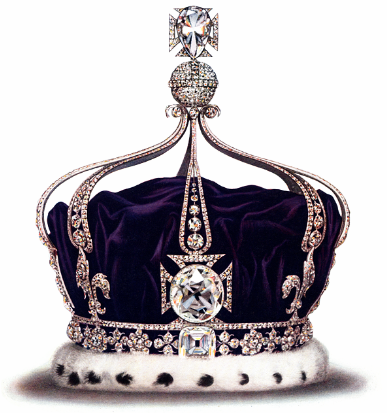 |
| The Koh-i-Noor in the cross of Queen Mary's Crown |
Duleep is shown the Koh-i-Noor
Maharaja Ranjit was never the original owner of the famous diamond. Lady Login, the wife of Dr. Logan, mentioned in her memoirs that the subject of the Koh-i-Noor was never mentioned in Duleep’s presence because it was a painful reminder of the loss of his dynasty’s imperial sovereignty.
The Queen, after her first meeting with Duleep Singh, asked Lady
Login whether ‘the Maharajah ever spoke of the Koh-i-Noor, and if so, did he seem
to regret it?’
Once assured that showing the Koh-i-Noor would not provoke Duleep, the Queen showed him the diamond during her portrait sitting at the palace.
Lady Login feared he would hurl the diamond out of the window in a fit of rage, but instead, Duleep remained speechless for several minutes. He trembled as he took the precious stone in his hand, gazing at it intensely and noting how the re-shaped diamond sparkled much more than before.
Once assured that showing the Koh-i-Noor would not provoke Duleep, the Queen showed him the diamond during her portrait sitting at the palace.
Lady Login feared he would hurl the diamond out of the window in a fit of rage, but instead, Duleep remained speechless for several minutes. He trembled as he took the precious stone in his hand, gazing at it intensely and noting how the re-shaped diamond sparkled much more than before.
 |
| Koh-i-Noor cutting cartoon (Punch, 31 July 1852) |
Although Ranjit Singh wore the Koh-i-Noor
as an arm-band, the Queen wore it as a brooch. Much later in 1937, it was
crafted into the Queen Mother's crown for the Coronation of George VI.
A guilty conscience kept Queen Victoria uneasy about the way in which the diamond had been snatched. Writing to her eldest daughter, Princess Alice, she confided:
"No one feels more strongly than I do about India or how much I opposed our taking those countries and I think no more will be taken, for it is very wrong and no advantage to us. You know also how I dislike wearing the Koh-i-Noor".
A guilty conscience kept Queen Victoria uneasy about the way in which the diamond had been snatched. Writing to her eldest daughter, Princess Alice, she confided:
"No one feels more strongly than I do about India or how much I opposed our taking those countries and I think no more will be taken, for it is very wrong and no advantage to us. You know also how I dislike wearing the Koh-i-Noor".
 |
| Maharani Bamba Duleep Singh (1886) |
Facing the reality of a lost Kingdom and the Koh-i-Noor, Duleep could only dream of Cinderella. Victoria had placed a severe restriction on him: ‘have a Christian wife of Eastern origin or marry an Indian princess educated in England'.
The Queen and her husband encouraged Duleep to court their
godchild, Indian ‘convert’ Princess Gouramma of Coorg. While he showed little
interest in this unsuitable promiscuous Princess, European aristocratic
families had no intention of having him as a son-in-law.
Maharani Jind Kaur, passed away on 01 August 1863 in England, and grief-stricken
Duleep sailed to India to cremate her. When permission to cremate her in Punjab
was denied, he scattered her ashes at Godavri river at Nashik (Maharashtra) in
February 1864.
On his way back to England, feeling lonesome and frustrated,
Duleep fell for a commoner and wedded her at the British Consulate (Alexandria)
on 07 June 1864. This was Bamba Müller (BUMBA, meaning ‘pink’ in
Arabic) who taught at the American Presbyterian Mission school at Cairo. She was
born out of wedlock in 1848 to an Abyssinian (Ethiopia or Habash) slave and an
already married German merchant banker named Ludwig Müller from Todd Müller and
Company.
British grooming effectively damaged Duleep’s childhood. Because
he ignored the British
monarchy’s obsession with maintaining a bloodline, he married beneath him, first to
Bamba Müller, and then to his Cockney
chambermaid, Ada Douglas Wetherill, on 20 May 1889 at La
Madeleine, Paris.
Duleep had six children from Bamba Müller (later known as Maharani
Bamba Duleep Singh):
1) Prince Victor Albert Jay Duleep Singh (10 Jan 1866 - 07 Jun 1918)
2) Prince Frederick Victor Duleep Singh (23 Jan 1868 - 15 Aug 1926)
3) Princess Bamba Sophia Jindaan Duleep Singh (29 Sep 1869 - 10 Mar 1957)
4) Princess Catherine Hilda Duleep Singh (27 Oct 1871 - 08 Nov 1942)
5) Princess Sophia Alexandra Duleep Singh (08 Aug 1876 - 22 Aug 1948)
6) Prince Albert Edward Duleep Singh (1879 - 01 May 1893)
Duleep also had two children from his marriage to Ada Douglas Wetherill (15 January 1869- 6 August 1930)
2) Prince Frederick Victor Duleep Singh (23 Jan 1868 - 15 Aug 1926)
3) Princess Bamba Sophia Jindaan Duleep Singh (29 Sep 1869 - 10 Mar 1957)
4) Princess Catherine Hilda Duleep Singh (27 Oct 1871 - 08 Nov 1942)
5) Princess Sophia Alexandra Duleep Singh (08 Aug 1876 - 22 Aug 1948)
6) Prince Albert Edward Duleep Singh (1879 - 01 May 1893)
Duleep also had two children from his marriage to Ada Douglas Wetherill (15 January 1869- 6 August 1930)
 |
| Elveden Hall (Suffolk, England) |
8) Princess Ada Irene Beryl Duleep Singh (25 Oct 1889-14 Sep 1926)
Duleep's decadent lifestyle
The wild-spending Duleep threw extravagant parties, was an amazing sportsmanship, and possessed royal charm that lit up large halls. This helped him become a serial playboy for society beauties. Since England was without nautch girls, he resorted to chasing after female servants. Prince of Wales became a close friend and his frequent visits to Duleep's 17,407 acres £50,000 estate, Elveden Hall, created plenty of excess associated with Victorian aristocracy.
By the 1880s, Duleep Singh was tired playing an English country squire, overweight and depressed, less sociable, and very bitter about his treatment at the hands of the British. He was also running out of money.
A knight in dull armour
The British noted how the Indian masses obediently prostrated at the feet of their elites, hence the Queen gave away Knighthoods, mantles, badges, sashes, chivalric titles, social rankings, and gun salutes as 'conspicuous merit and loyalty rewards'.
 |
| GCSI badge |
Correspondence between British officials shows that they wanted the Indians to obey the British and refrain from mutinying. Sustained attacks on the uniting force of faith and social coherence turned the Indians into self-loathing Anglophiles who adored English culture, education, and science.
In the next article on Duleep Singh, we shall read about how this outwardly English Prince became fully Indian, mutinied and declared war on his royal tormentors.
©Tahir Gul Hasan, 2019
Articles linked to this story
Photo credits
1) Sir Duleep Singh (1860s)
2) Franz Xaver Winterhalter (jewel-framed miniature of Victoria around neck by Emily Eden)
3) The Golden Throne of Ranjit Singh
6) Duleep in ceremonial dress - 1852 (by George Duncan Beechey)
8) Maharaja Sir Duleep Singh in ceremonial dress, 1861
11) Subedar of the 21st Bengal Native Infantry (1819)
Referenced work
Soldier and traveller (Colonel Alexander Gardener)
Acknowledgement
If I were to list all the references the old-fashioned away right here, this article would be twice its current size. If I were to list all the references the old-fashioned away right here, this article would be twice its current size. Included in the text are some web links (URLs). Just click on the words in blue colour and you will reach those other pages that contain either the text used (after laborious editing) or more information. I visited hundreds of web sites while researching for material on Maharaja Duleep Singh. Omissions, if any, were unintentional. I thank those from whom obtaining permission to use some images was either impossible or who did not respond to my requests.
DISCLAIMER
No one must misconstrue the information presented here about any character as disinformation or insults. The information here was meticulously-collected and cross-checked from numerous sources on the internet (without the use of proxy servers in Pakistan). Please email your suggestions (with believable references) if you feel something requires correction.


